Showing posts with label twitter chat. Show all posts

Monday, 7 March 2016

The Importance of Play - Games in the Classroom

I have been working with an incredible young entrepreneur in Toronto. Kevin Munn has worked in education for seven years. He has been a Child and Youth Worker, ESL teacher and tutor. I know that I would have loved to have had Kevin work with me and my students. He is responsive to student needs and interests, creating games for them to learn and practice skills. Games helped Kevin learn when he was a student and he created games for the students he worked with. Students with a variety of academic, social and emotional needs responded positively, engaged in their learning. His games became popular with teachers and he created sets for them, even buying his own personal laminator to set up customizable games for them. 
Captain Handsome and my MIL tested the games before I brought them to the ESL class
This year, Kevin's company, Hungry Minds Academy has created "Academy in a Box" - four fully-customizable card and board games for students. I have been using several of the games with my Hotel ESL class and the Syrian refugee youth have been able to understand and engage with them easily.

Kevin is joining #cdnedchat tonight from 8-9 p.m. EST for a chat about the importance of play, particularly about why we should and how we could use board games in the classroom.

He is passionate about empowering students to learn at home and at school and has done the research to back up his product line. Tonight, Kevin's questions are based on a five-year evidence based study (including the complied results of sixty independent studies) about the benefits of gameplay on learning.
Tonight's chat will ask you to read some of Kevin's discoveries before you share your own experience. We don't usually give you a sneak preview, but here are Kevin's questions and what we'll be talking about in #cdnedchat tonight:

Q1: How do you use games (esp board games) in your classroom?

Games are inherently engaging to most students, but how they are used determines how effective they can be in a classroom.  Teachers who use games deliberately have the best results.
Many game mechanics include an element of competition, but that can be downplayed, so that learners see that the competitive aspects are not the focus. (Shauna's note: competition is not inherently evil, but competition and learning don't play well together)
Q2: How do you use inconsequential competition in class?

If games do not focus on important academic content, they will have little or no effect on student achievement.

Q3. How do you work essential academic content into games?

The studies referred to found the most common error teachers make when using games is after the games are complete.  Often teachers just add up team points and move on.  They miss out on the opportunity to debrief to go over aspects that are now clearer, were most difficult at the time, etc.

Q4. How long do you debrief after games, and what do you discuss?
Another boost in the effectiveness of games in the classroom was found in having students take notes on the game/lesson afterwards.  Or to allow students to go back and correct homework, etc. with this new knowledge.
Q5. How can you have students reflect or act on what they learned from their participation in games?

Monday, 14 December 2015

Using the Internet for Awesome

Some people hate Twitter chats. I am not one of those people, but I'm always interested to understand WHY people love or hate things. The complaint about Twitter chats is often that they are one-hour long echo chambers about the same topics that have been discussed over and over.

I have benefited greatly from a huge variety of Twitter chats. When I first joined the initially overwhelming stream of discussion topics tied to #edchat hashtags, I liked the questioning format of: How do you define x in education? How do you use x in your teaching? What are the problems with x in education? What are some resources to learn more about x? I connected with interesting people, got to share stories from my classroom and was inspired to try new things.

As I become more comfortable with online collaboration, 140 characters at a time, I want to push the envelope (like my friends Sean "#2pencilchat" Farnum, Doug "#weirded" Robertson and Ross "#totallyrossome" LeBrun). A few weeks ago, the incredible team at #cdnedchat (who l am thrilled to be a part of this year) embraced the idea of a virtual escape room, and #eduescape was born. The chat bucked the convention and participants were issued challenges that they had to complete before unlocking the questions about how to create immersive, interactive experiences in their classrooms.

When the other moderators at #cdnedchat invited me to host a chat about my new book, "Creating Classroom Magic: Using Lessons from the Life of Walt Disney to Create an Experimental Prototype Classroom of Tomorrow," I wanted to do something a little different. Because I believe strongly in practicing what I teach, I couldn't write a chat that stuck to the familiar format. Instead, I wondered if participants in a 60 minute chat could, in fact, use the power of social media and a PLN (Professional/Personal Learning Network), to make magic. Rather than talking about magic, we're going to try to make it. My hope is that we will be able to make a real change to someone in our hour together.

One of the recurring themes in edchat conversations is how wonderful it is to be a "connected educator" on Twitter and how powerful social media is. I want to test those assertions. How powerful can our voices be?


In the 24 hours leading up to the chat, as I refined the format and questions, I tweeted to members of my PLN who I know have wonderful ideas and great networks. I asked them to both join us and retweet the invitation to the chat. Several retweets and comments have made me optimistic that we'll have a large crew present to:
  • Amplify our voices, stories and ideas in real time
  • Be Brave to share the things that mean the most to us, our students and our communities
  • Collaborate to raise awareness or funds (or even items) for something we care about
  • Determine causes, stories, issues and ideas that would benefit from our help
  • Empathize with others
  • Find ways to take action
(extra points if you noticed how that list was organized!)

Some things to think about that will help you participate in this chat experiment:
  • Let's do something unexpected. Creating magic is about surprising someone, giving them more than they expected and filling them with wonder. How may we do that using Twitter?
  • I am going to try to create as much of a collaborative learning space as possible. If you have suggestions on how to make this better, please share them!
  • What do you think to yourself, "I wish everyone knew about...." (I wrote a post this summer after a tweet I posted about a dead raccoon went kind of viral, exploring what I wish went viral, including #unicorns4molly)
  • The format may be a little different than you're used to, but we'll use Q1/A1 to sort out our thoughts
  • The ideas and stories that engage us might be different. I'm not sure what the result(s) of this chat may be, but want to make sure that everyone feels good about what we accomplish together!
  • You will likely become engaged with other participants and want to continue the conversation, you can do so in the chat with the hashtag #cdnedchat, in DMs (direct messages) and/or long after the chat has finished. If you break off and have a conversation or planning session in DMs, please come back to the chat and share what you've planned!
  • It's totally fine if you have to catch up once the hour is done! We'll monitor the hashtag for a while afterwards!
  • Consider bookmarking interesting links that are shared during the chat so you can come back later and read further.
  • I hope that we can be productive, hopeful and have an impact in one hour. I know that we can do all of those things in a day, a week, a month, a year or a lifetime. I hope that you'll find something in this hour that you want to pursue well beyond it. 
If you follow me on Twitter, you may notice that I often post videos, stories and pictures with the hashtag #DailyCry or a description of "all the feels" or the goosebumps said link produced in me. I search for and post things like this because I believe, despite everything, that humans are good. Watching the news, or even scrolling through a Facebook feed, it can be hard to remember this. In addition to exploring tough issues, I think we need to embrace and share the stories of people doing good, and, as Mr. Rogers said, "look for the helpers."


Over the past week, there have been tons of wonderful news stories, and stories of helpers. Here are just a few I found:

  • Safyre Terry now has boxes filled with Christmas cards. This young girl was badly burned and lost her family in a house fire caused by arson. She lives with her aunt, who shared a photo of Safyre, by a Christmas card tree, and a wish that the tree be filled up.
  • A Florida McDonald's Drive-Thru had a 250 person streak of "paying it forward."
  • Sports Illustrated's High School Athlete of the Month is a big brother that led his community in fundraising to create an inclusive playground, so that his little brother, who has Cerebral Palsy, could play with his friends. How did he fundraise? He carried his brother on his back for two treks (totalling nearly 100 miles) he calls the "Cerebral Palsy Swagger."
  • Students are wearing orange to support a schoolmate with cancer who was being bullied online.
  • Residents of a drop in and rehab centre, who are homeless, donated money to the Children's Wish Foundation. The money was raised by collecting and recycling cans.
  • High school students practiced empathy in a project called, "Walk a Mile in Her Hijab" where students who don't normally wear a hijab spent a day wearing them.
  • A grade 8 student made a video board to help his friend communicate. Because he was struck by lightning, his friend was unable to communicate effectively. This young inventor created a device ethat his friend can control by moving his head to answer "yes" and "no." 
  • This has been an exciting week in Canada, as the newcomers (Syrian refugess) that are sponsored privately and by our government begin to arrive to their new homes. Teach Kids News has an article about the newcomers to Canada (this is a great website that features articles written in kid-friendly language, and has curriculum connections for every news story.
  • A children's choir in Ottawa (my hometown) learned and performed a historical Arabic song to welcome newcomers.


Some of the above stories have gone viral. All of them, and so many more, deserve to.

Who would benefit from our help? Let's figure it out together? Edvengers (yes, I went there) Assemble!


I can't wait to hear YOUR stories and help make some magic in tonight's #cdnedchat.

Monday, 26 October 2015

Reflecting on Reflecting

Reflecting on reflecting is a funny thing. It starts to feel like an Esher painting as you think about the importance of the importance of thinking about how you think. Even that sentence has my brain in knots.

I have learned that, for me, self-reflection is the key to my own learning. For years, I told my students it was key to theirs' and helped them do it, with some effectiveness. It isn't until recently that I realized I wasn't doing very accurate self-reflection.

The problem was, I wasn't practicing what I was teaching. I told my students to celebrate their efforts, not just their successes. I told them to internalize positive feelings and feedback. I told them to objectively look at themselves and their work and appreciate what they were doing. I told them to look for ways in which they could continue to improve and grow.

The only one of those that I was effectively, consistently doing myself was the last. I am really good at finding things I need to get better at.

All of the positive aspects of reflection that I taught my students were falling on my own deaf ears and mind.


Recently I realized that when I told myself I was reflecting, what I was doing looked more like the Magritte painting above. I tried to examine my actions and thoughts in a mirror, instead I blocked myself off. I looked at the back of my head. I was really good at looking back and terrific on focusing on what didn't go as well as I'd hoped.


When I would ask my "Mirror, Mirror on the wall" how I was doing, a very angry version of myself was more than eager to respond with criticisms and a tongue-lashing.

I discovered that, instead of treating myself as I would expect my students to treat themselves, with kindness and honesty, I was behaving as if I had a panel of judges commenting on every choice and action. Although the audience loves a harsh judge, like Simon Cowell, on a panel, if all we had were Simons, people would change the channel. My internal panel was filled with versions of Simon Cowell and they dictated to me how I "should" feel about myself and my work.


In Inside Out, things go very wrong for the protagonist, Riley, when Joy and Sadness leave the control panel to be operated by Fear, Anger and Disgust. In thinking about myself, I realized that I let those three take the reins for my self-reflection for far too long.


Realizing how inaccurate my perception of myself was ended up being the easy part. I acknowledged that it wasn't helpful or productive, but I had a huge fear (look who's driving again) that I'd over-inflate myself image. I worried that I'd become the house cat who saw herself as a lion.

Finally, I have begun to figure out how to be a better reflector.

Here is what I have learned.

1. Quit judging yourself for thinking about yourself. Everyone does it. No one thinks of us nearly as much as we think of ourselves. If you're worried others are judging you, they probably aren't. They're too busy working on themselves.

2. Balance being genuine and honest with being gentle and humble. I consider genuine as being truthful with others and honest as being truthful with myself. I have to be truthful with myself before I can truly be myself around others. Though I try to be genuine and honest, I am aware of the need to be gentle with myself and humble towards others. This has been extremely difficult for me. To help in gentleness, I picture myself as the four-year-old version of me and it's easier to treat her better. Humility is scary. I want to share my learning and successes, but worry that others will perceive what I share as bragging.

3. Projecting isn't the same as reflecting. For my whole life, I have projected confidence and self-esteem. People around me think that I have my stuff together and might be surprised to learn that what I project into the world does not match how I feel about myself. What I see reflected is described above. The best way I can describe it is dysmorphia, instead of seeing my body as something different than it is, I see my entire self in the most critical way possible. I am working on reflecting more accurately, so that what I project is more genuine.

4. Taking the time to reflect means accepting vulnerability. By honestly looking at yourself, your choices and your actions, you are open to all kinds of feelings. Seeing yourself as you truly are and accepting that you are in a constant state of becoming isn't easy. Even reflecting silently in a journal can rip you open. If you want to really feel raw, try making that journal public and blogging about it.

5. Despite everything, reflecting is one of the most valuable things I do. Thinking about my thinking, thinking about my progress and setting goals keep me moving forward.

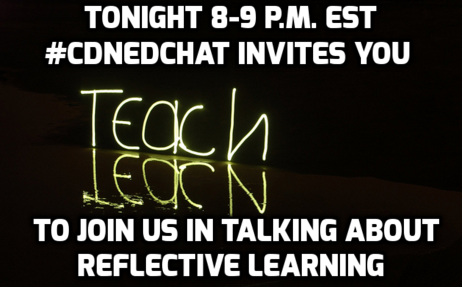
Tonight, I'm co-moderating #cdnedchat with the amazing Dana Ariss. We'll be talking about reflection in education.